Policy research and advocacy organisation Africa Education Watch has warned that Ghana’s Free Senior High School and Technical and Vocational Education and Training (Free SHS/TVET) system may face significant strain in accommodating all qualified students this year, citing growing pressure on available school infrastructure and declining transition efficiency.
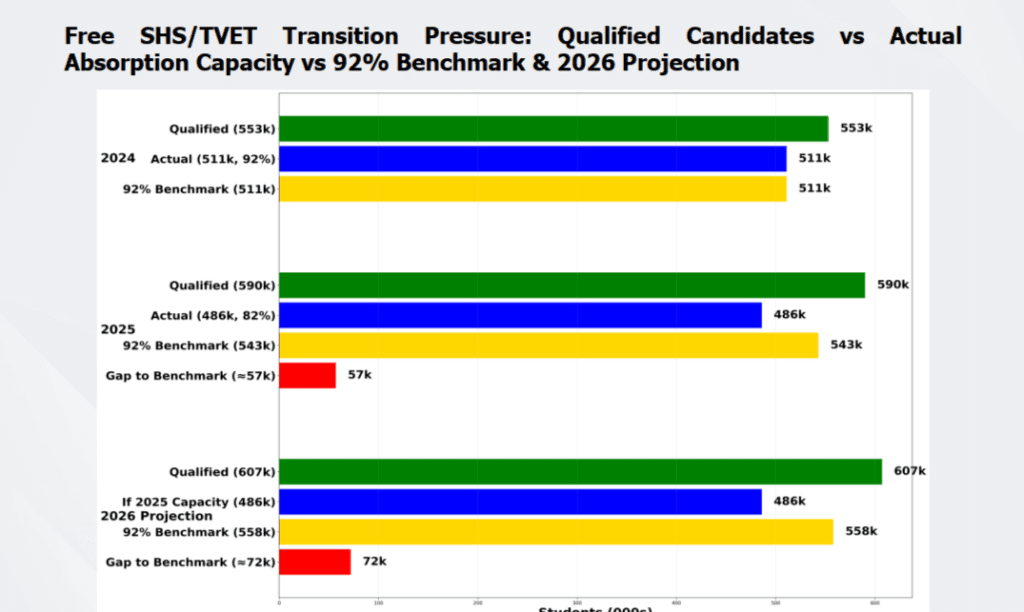
In its latest Education Alert Policy Brief, Volume 37, the organisation projected that although approximately 620,000 candidates sat for the 2025 Basic Education Certificate Examination (BECE), an estimated 607,000 are expected to qualify for placement into senior high and technical vocational institutions.
However, Eduwatch cautioned that existing school capacity may fall short of demand, potentially leaving about 72,000 qualified students without placement if urgent interventions are not implemented before the admissions process begins.
The report attributed the emerging gap to a combination of structural and operational challenges within the secondary education system. Chief among them is a reduction in intake capacity linked to the phased rollback of the Double Track system in some schools, alongside persistent mismatches between available vacancies and student preferences.
Eduwatch also cited geographic disparities in school distribution and limited gains from ongoing efforts to integrate private senior high schools into the Free SHS framework as contributing factors worsening the placement outlook.
According to the organisation, transition efficiency, a measure of how effectively qualified students move into secondary education has declined sharply from 92 per cent in 2024 to 82 per cent in 2025.
The policy brief warned that the downward trend could intensify pressure on the placement system and expose deeper weaknesses in Ghana’s secondary education infrastructure.
“Declining transition efficiency… could generate an effective placement deficit of approximately 72,000 qualified candidates if immediate policy interventions are not undertaken,” the report stated.
The warning comes as Ghana continues to grapple with increasing enrolment under the Free SHS policy, introduced in 2017 to expand access to secondary education. While the programme has significantly increased participation rates, concerns over overcrowding, infrastructure deficits and resource constraints have persisted in recent years.
Eduwatch said the 2026 admissions cycle could become particularly challenging if infrastructure expansion and placement reforms fail to keep pace with rising student numbers.
To avert a potential crisis, the organisation called for expedited expansion of boarding facilities, faster completion of ongoing school infrastructure projects, and improvements in the efficiency of the national placement system ahead of the August placement period.
The group also urged authorities to make better use of private sector capacity to reduce pressure on public institutions.
Failure to implement urgent reforms, Eduwatch warned, could result in what it described as the most severe secondary education transition bottleneck in Ghana’s history.