


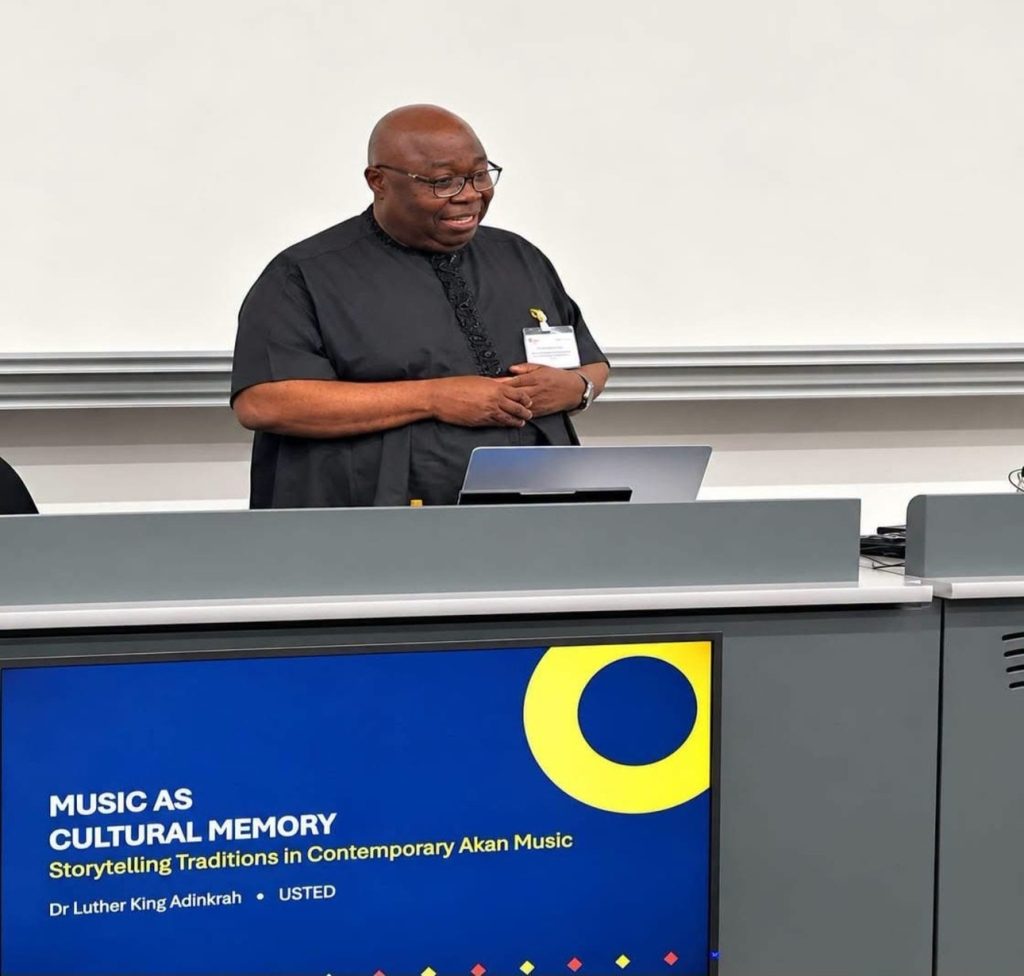
Ghanaian academic and musician Dr Luther King Adinkrah has urged contemporary African musicians to look beyond entertainment and recognise their role in preserving history, culture and traditional knowledge.
According to him, African music has historically served as a powerful medium for storytelling, cultural preservation and the transmission of values across generations.
Speaking on the topic “Music as Cultural Memory: Storytelling Traditions in Contemporary Akan Music,” Dr Adinkrah said musicians have a responsibility to document and preserve Africa’s oral traditions while adapting them to contemporary audiences.
“The artist is often more than an entertainer. The artist becomes a historian. Sometimes the artist becomes a moral voice,” he said.
He noted that African storytelling has long existed through songs, chants, proverbs and traditional instruments, citing the role of griots in Mande royal courts and fontomfrom and atumpan drummers in Asante royal courts.
Dr Adinkrah said contemporary genres including highlife, Afrobeats, hiplife, rap, Afro-fusion and Amapiano continue this tradition, even as the platforms and musical styles evolve.
“The instruments may be modern, the platforms may be digital, and the audience may be global, but the storytelling impulse remains deeply African,” he said.
Music as a record of history
Using three of his songs, “Metowo Kropon,” “Feyiase” and “Mmoatiahene,” Dr Adinkrah demonstrated how contemporary music can preserve and reinterpret African history, folklore and cultural memory.
He explained that “Metowo Kropon” explores the cultural significance of naming, presenting it as more than an expression of personal identity or affection.
Drawing on Akan oral tradition, he referenced the story of Okomfo Anokye and the naming of Kumasi and Kumawu, arguing that names can preserve stories about the origins, experiences and aspirations of communities.
“Naming a place is itself an act of memory,” he said.
He also used “Feyiase” to demonstrate how music can transform historical events into emotional narratives. The song draws inspiration from the historic Battle of Feyiase between the Asantes and Denkyiras but retells the conflict through a fictional love story.
According to Dr Adinkrah, such storytelling allows contemporary audiences to connect with historical events through human emotions and experiences.
Keeping folklore alive
His third song, “Mmoatiahene,” draws from Akan folklore and childhood storytelling traditions surrounding Christmas celebrations.
The song incorporates the traditional belief that the Akonkodee tree was associated with dwarfs and supernatural forces, blending folklore with a romantic narrative.
Dr Adinkrah said the use of contemporary musical rhythms makes such traditional stories accessible to younger audiences while retaining important elements of Akan cultural heritage.
He argued that this approach is particularly important at a time when digital platforms are transforming how young people consume music and stories
He further described the “kwardwom” of the Asante royal court as a repository of knowledge, history and cultural memory.
Dr Adinkrah called for greater recognition of the cultural and historical responsibilities carried by African musicians.
“Africans do not only live by sound and rhythm; we live by the meaning of sound and rhythm,” he said.


