


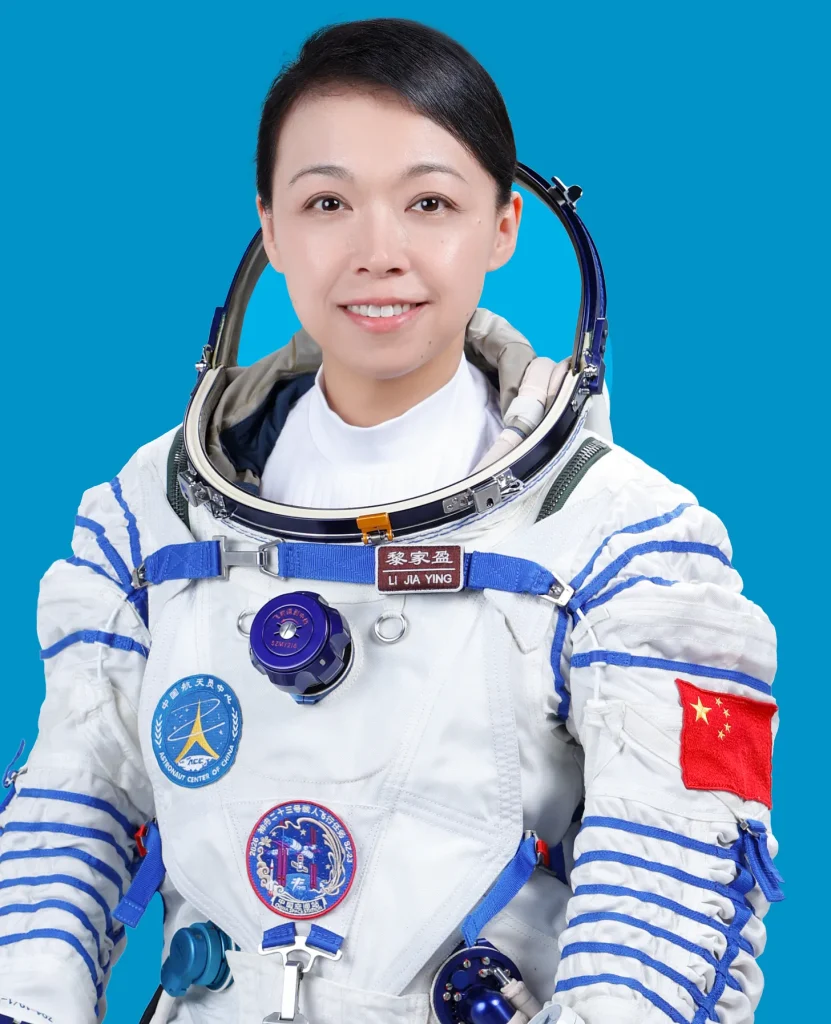
A Hong Kong astronaut has travelled to space for the first time aboard Shenzhou-23 as part of China’s latest mission to its Tiangong Space Station.
Li Jiaying, a 43-year-old police officer and mother of three, is serving as the payload scientist in the three-member crew that launched on Sunday night.
The mission is considered another major milestone in China’s growing space programme, which aims to land humans on the moon by 2030 amid increasing competition with the United States, which is targeting a crewed lunar landing by 2028.
The spacecraft blasted off from the north-west Gobi desert aboard the Long March 2F rocket at 11:08 p.m. local time on Sunday before successfully docking with the Tiangong space station hours later.
Apart from Li Jiaying, the crew also includes Zhu Yangzhu, a 39-year-old space engineer, and Zhang Zhiyuan, a 39-year-old former air force pilot.
One member of the crew is expected to spend a full year in orbit as part of a major scientific experiment, although Chinese authorities are yet to determine who will undertake the extended stay.
The Shenzhou-23 mission will focus on several scientific studies, including research into the effects of microgravity on the human body.
Large crowds waving Chinese flags gathered to witness the launch, which many described as another symbol of China’s technological progress.
Hong Kong Chief Executive John Lee described Li’s participation in the mission as a “historic” moment.
Li said she was inspired by Yang Liwei, the first person sent into space by China’s space programme.
“This is a rare chance. Why not try?” she said in remarks carried by Chinese state media.
Ahead of the launch, Li also expressed pride in representing China in space exploration efforts.
“How high our Chinese spacecraft flies, that’s how high we can hold our heads high,” she said.
Analysts say stories of successful figures such as Li could help Chinese authorities promote patriotism among young people, particularly in Hong Kong.
Since 2021, China has regularly sent astronauts to the Tiangong space station for six-month missions as it continues expanding its expertise in long-duration space travel and deep-space exploration.
The expected year-long stay by one crew member would rank among the longest space missions in history, falling just short of the 14-month record set in 1995 by Russian cosmonaut Valery Polyakov.
Astrophysicist and professor at Macquarie University, Richard de Grijs, said the longer mission would push both astronauts and spacecraft systems into a more demanding operational phase compared to earlier missions.
China has continued to make major advances in its space programme in recent years. In 2024, its Chang’e-6 mission successfully returned rock samples from the far side of the Moon to Earth for the first time.
Later this year, China is also expected to conduct an orbital test flight for the Mengzhou spacecraft, which is being developed to transport astronauts to the moon.


